MICROFLOCK: sustainable innovation that reinterprets the comfort of down
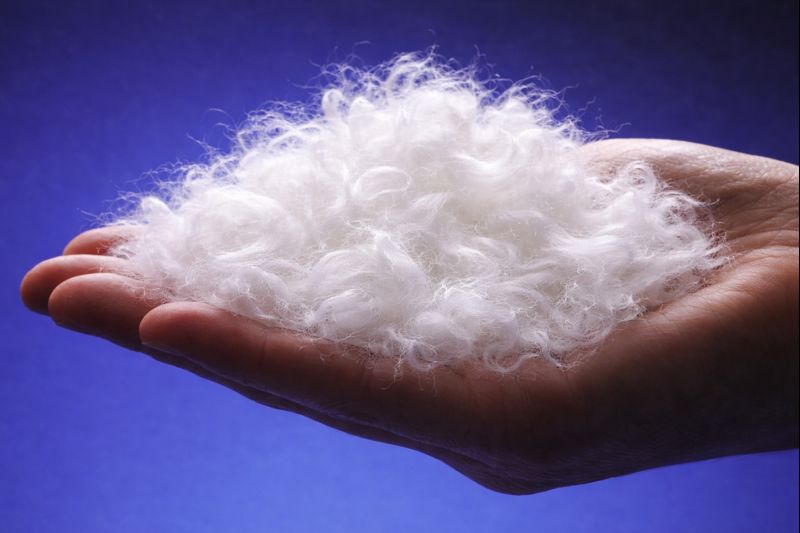
The softness and comfort of down meet the research and innovation of a new generation of synthetic fibres. This is the concept behind MICROFLOCK, a microfiber developed to deliver high performance, design versatility and a greater focus on sustainability.
A new generation of filling materials
One of the greatest challenges in the development of synthetic fibres has always been to reproduce the characteristics that make natural down such a unique material: lightness, softness, breathability, thermal insulation and enveloping comfort.
MICROFLOCK was developed precisely from this research.
It is an extremely fine polyester microfiber, with a diameter of just 14 microns. To give an idea of its exceptional lightness, 10,000 metres of fibre weigh only 14 grams.
The special structure of the microfibers promotes the free circulation of air, contributing to the material’s breathability. At the same time, the overlapping fibres create countless micro-spaces capable of trapping and storing air, according to a principle similar to that of goose down.
The result is a lightweight, soft and voluminous material designed to provide an exceptionally pleasant level of comfort.
From technical apparel to upholstered furniture
MICROFLOCK has also been successfully used for several seasons in the technical apparel industry, where lightness, insulation and recovery properties are essential.
The experience gained in this field led A. Molina & C. S.p.A. to further explore its potential, identifying the upholstered furniture industry as a particularly interesting area of application.
Designers and manufacturers of sofas and armchairs are constantly looking for materials capable of providing a sensation similar to down: a filling that gently embraces the body, progressively adapts under pressure and offers controlled elastic recovery, without the typical “rubber effect” associated with fibres that return too quickly to their original shape.
MICROFLOCK responds to this need with properties designed to combine softness, adaptability and shape recovery.
Comfort designed to last
MICROFLOCK is a high-tenacity fibre with excellent recovery properties after deformation, even under conditions of high temperature and humidity.
The extremely short cut of the microfibers also allows the filling to be fluffed and reshaped, helping cushions regain their original form after compression.
The microfiber is processed into special closed clusters, using a process designed to reduce fibre cohesion. This makes MICROFLOCK easy to blow-fill using the same machinery normally employed for feather and down filling.
Its softness is combined with excellent filling capacity and good resistance to deformation, giving designers extensive freedom in the development of cushions, seating and high-comfort upholstered products.
MICROFLOCK and sustainability: GRS-certified recycled fibre
The evolution of the MICROFLOCK project also extends to the origin of its raw material.
MICROFLOCK is made using fibre obtained from recycled bottles and PET and is GRS – Global Recycled Standard certified.
This makes it possible to combine the pursuit of performance with greater attention to the use of recycled materials and supply-chain traceability.
Sustainability therefore becomes an integral part of product development: innovation is not only about achieving new levels of performance, but also about developing materials capable of responding to the evolving needs of industry and the market.
MICROFLOCK and down: what do the tests show?
At Molina, research goes beyond the perception of comfort.
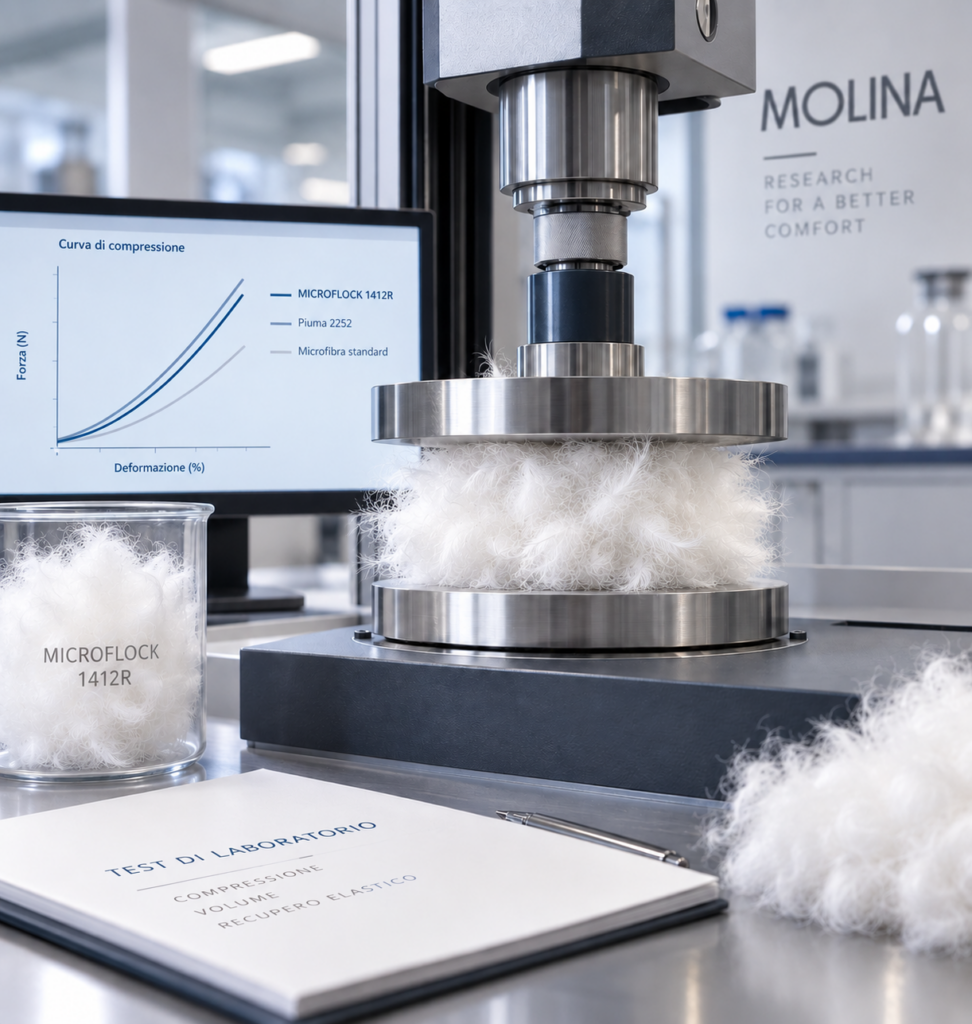
In its in-house laboratory, the company has developed a testing method to measure performance under load, filling power and delayed elastic recovery of materials intended for filling applications.
The aim is to identify and measure significantly different behaviours.
Some materials have high elasticity and return almost immediately to their original shape, producing what can be described as a “rubber effect”. Others adapt more naturally to the shape of the body, with reduced counter-pressure and a more gradual recovery of their original volume, coming closer to the typical “down effect”.
It is precisely this balance between softness, adaptability and support that plays a decisive role in the perceived quality and comfort of a seat.
Performance comparison
Molina’s tests examined four different types of filling materials:
- Feather 333 – Standard White Goose and Duck Feather
- Feather 2252 Gold Label – Assopiuma Standard
- MICROFLOCK 1412R
- Standard Polyester Microfiber Fill 1.1 × 32 mm
Of particular interest is the comparison between MICROFLOCK 1412R and Feather 2252 Gold Label – Assopiuma Standard.
The tests show comparable performance for some of the parameters analysed, both in terms of free volume and under compression.
After compression, the free volume of MICROFLOCK 1412R reaches 221 mm, compared with 205 mm for Feather 2252. In the compressed volume test, MICROFLOCK records 112 mm, compared with 140 mm for Feather 2252.
These results provide an objective assessment of the material’s behaviour and confirm the potential of MICROFLOCK 1412R for applications requiring a synthetic filling with comfort characteristics inspired by down.
Molina research: developing the future of comfort
The quality of a filling, however, does not depend on the filling material alone.
The final result is determined by the interaction between the filling material, technical containment fabrics, internal structure and cushion construction technique. For this reason, Molina recommends complementing material testing with specific tests performed on the finished product.
Mechanical properties, compression response and recovery times are verified in Molina’s in-house laboratory through tests and controls carried out throughout the production process.
This approach combines experience, research and performance measurement to provide the upholstered furniture industry with increasingly advanced filling solutions.
MICROFLOCK represents this evolution: a GRS-certified recycled microfiber developed to reinterpret, through technology, some of the most appreciated qualities of down and offer designers and manufacturers new possibilities in the creation of comfort.